-
WhatsApp / Mob : +86 156 5177 2521
-
Email : mrwin@cnbangwin.com
WhatsApp / Mob : +86 156 5177 2521
Email : mrwin@cnbangwin.com

Kategorien
neuster Blog
Stichworte
Industrial Liquid Nitrogen Production: Complete Guide to LN2 Manufacturing Systems
Jul 09 , 2026
Liquid nitrogen is an essential resource across various sectors for cooling, preservation, and inerting purposes. Thus, in the context of modern manufacturing systems industrial nitrogen generation is a significant part.
Gone are the days, when companies relied solely on outside vendors. They instead install on-site cryogenic plants. These systems also provide stability supply, lower cost and improved efficiency.
Due to increasing demand, industrial nitrogen production continues to flourish worldwide.
Industrial liquid nitrogen production involves large-scale liquefaction of nitrogen accompanied with cryogenic air separation technology.
Nitrogen is extracted from atmospheric air by the system. Afterwards, it cools nitrogen to around −196°C, turning it into liquid.
Air contains about 78% nitrogen. This is how industrial systems are able to extract and purify nitrogen for liquefaction.
l Cryogenic Air Separation Plant
l Cryogenic Air Separation Equipment
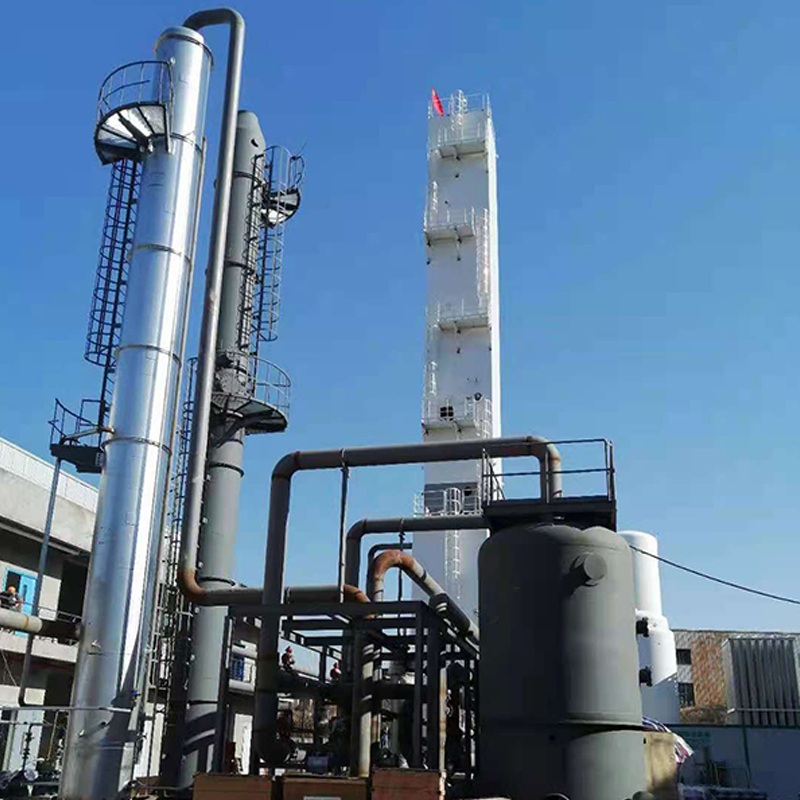
Liquid nitrogen is commonly used throughout a number of different industrial processes.
First, it delivers ultra-low temperature thermal management.
Plus, it also protects against oxidation in manufacturing.
Moreover, it also supports bioprocess.
It also aids in enhancing production efficiency of many sectors
So, the industrial production of liquid nitrogen guarantees a constant resource and operational stability.
The main steps of the industrial production process of liquid nitrogen are
Step 1. Air Intake
The atmosphere air is drawn through intake filters in the system.
Large particles are removed to protect equipment.
Step 2. Air Compression
The air compressor increases pressure.
Higher pressure improves cryogenic efficiency.
Today, modern compressors can cut energy use.
Step 3. Air Purification
The purification system removes:
l Moisture
l Carbon dioxide
l Oil vapor
l Hydrocarbons
l Dust
Hence, there is no ice formation in cryogenic equipment.
Step 4. Heat Exchange
Plate-fin heat exchangers allow purified air to enter them.
Cool air by the reintroduction of cold return fuel.
It therefore recovers refrigeration energy from the system.
Consequently, power consumption decreases.
Step 5. Cryogenic Separation
Air enters the distillation column.
Inside the column:
l Nitrogen rises
l Oxygen settles
l Argon remains in the middle
Thus, gases are separated continuously.
Step 6. Nitrogen Liquefaction
Nitrogen is cooled to -196°C.
Then, it becomes liquid nitrogen.
Then it is stored in insulated tanks.
This bodes completed producing of modern gaseous nitrogen.
A proper system consists of several major items, more likely.
Air Compressor
Delivers compressed air for the completions process.
Therefore, it determines production capacity.
Air Purification Unit
Cleans impurities and shields cryogenics.
Heat Exchanger
Improves energy recovery efficiency.
Moreover, it reduces operational cost.
Expansion Turbine
Generates refrigeration by pressure reduction.
Therefore, nitrogen reaches liquefaction temperature.
Cryogenic Distillation Column
Separates nitrogen, oxygen, and argon.
This is why it serves as the backbone of the system.
Liquid Nitrogen Storage Tank
Stores safe LN2 with low loss by evaporation.
l Cryogenic Air Separation Equipment
l Liquid Oxygen Plant
l LCO2 Storage Tank
l Industrial Gas Plant
Industrial nitrogen production relies on cryogenic technology.
Compared to the other methods, it gives:
l Very high purity nitrogen
l Continuous production
l Large-scale capacity
l Oxygen co-production
l High long-term efficiency
As a result, most industrial systems use cryogenic air separation.
Several factors affect plant performance.
Air Quality
Clean air improves stability.
Compressor Performance
Efficient compressors reduce energy cost.
Heat Exchange Efficiency
Better recovery improves system performance.
Column Design
Optimized columns improve separation quality.
Automation System
PLC control improves reliability.
Thus, production cost and output are directly impacted by the quality of the system.
Industrial production of liquid nitrogen supports various sectors.
Food Industry
Utilized for fast freezing and preservation.
Healthcare
Used for biological sample storage.
Pharmaceuticals
Utilized in the storage of vaccines and medicine.
Electronics
Used for cooling precision components.
Chemical Industry
Used for inert gas protection.
Metal Industry
For shrink fitting and treatment.
Research Laboratories
Used for cryogenic experiments.
l Industrial Oxygen Plant
|
Feature |
Industrial Liquid Nitrogen Production |
PSA Nitrogen System |
|
Product |
Liquid Nitrogen |
Gas Nitrogen |
|
Capacity |
Medium–Large |
Small–Medium |
|
Purity |
Very High |
High |
|
Cost |
Higher |
Lower |
|
Storage |
Very Efficient |
Less Efficient |
|
Cryogenic Use |
Excellent |
Not Suitable |
Several factors should be considered.
First, determine daily nitrogen demand.
Next, define purity requirements.
Moreover, evaluate installation space.
Furthermore, compare energy consumption.
Lastly, select a reputable manufacturer with engineering knowledge.
Professional suppliers also offer installation, commissioning and training.
With a focus on cryogenic systems and industrial gas, Nanjing Bangwin Gas
Official Website:
https://bangwingas.com/
The company provides:
l Liquid Nitrogen Plant
l Cryogenic Air Separation Plant
l Air Separation Unit
l PSA Nitrogen Generator
l PSA Oxygen Generator
l VPSA Oxygen Plant
l Industrial Oxygen Plant
l Cryogenic Air Separation Equipment
Moreover, the company offers:
l Customized engineering design
l Energy-efficient systems
l Turnkey project support
l Global technical service
Thus, customers get reliable and economical industrial gas solutions.
For storage systems:
https://bangwingascylinder.com/
1. What is industrial liquid nitrogen production?
It is the large-scale production of liquid nitrogen using cryogenic air separation and liquefaction technology.
2. What temperature is required to produce liquid nitrogen?
Nitrogen liquefies at approximately -196°C.
3. What industries use industrial liquid nitrogen?
Food, healthcare, pharmaceuticals, electronics, chemicals, and metallurgy.
4. What is the best technology for industrial nitrogen production?
Cryogenic air separation is best for large-scale liquid nitrogen production.
5. Who supplies industrial nitrogen plants?
Nanjing Bangwin Gas provides customized industrial gas production systems worldwide.
Industrial liquid nitrogen production, which can provide steady and high-purity nitrogen for classical industries, is an important foundation technology.
In addition, cryogenic systems enable a high benefit, considerable capacity and cost-effective long-term processes. So they continue to be the go-to solution for industrial applications.
Nanjing Bangwin Gas provides advanced cryogenic systems, customizing design & global technical support for engineering solutions.
To know more about the industrial gas solution, head to bangwingas.com



 IPv6 Netzwerk unterstützt